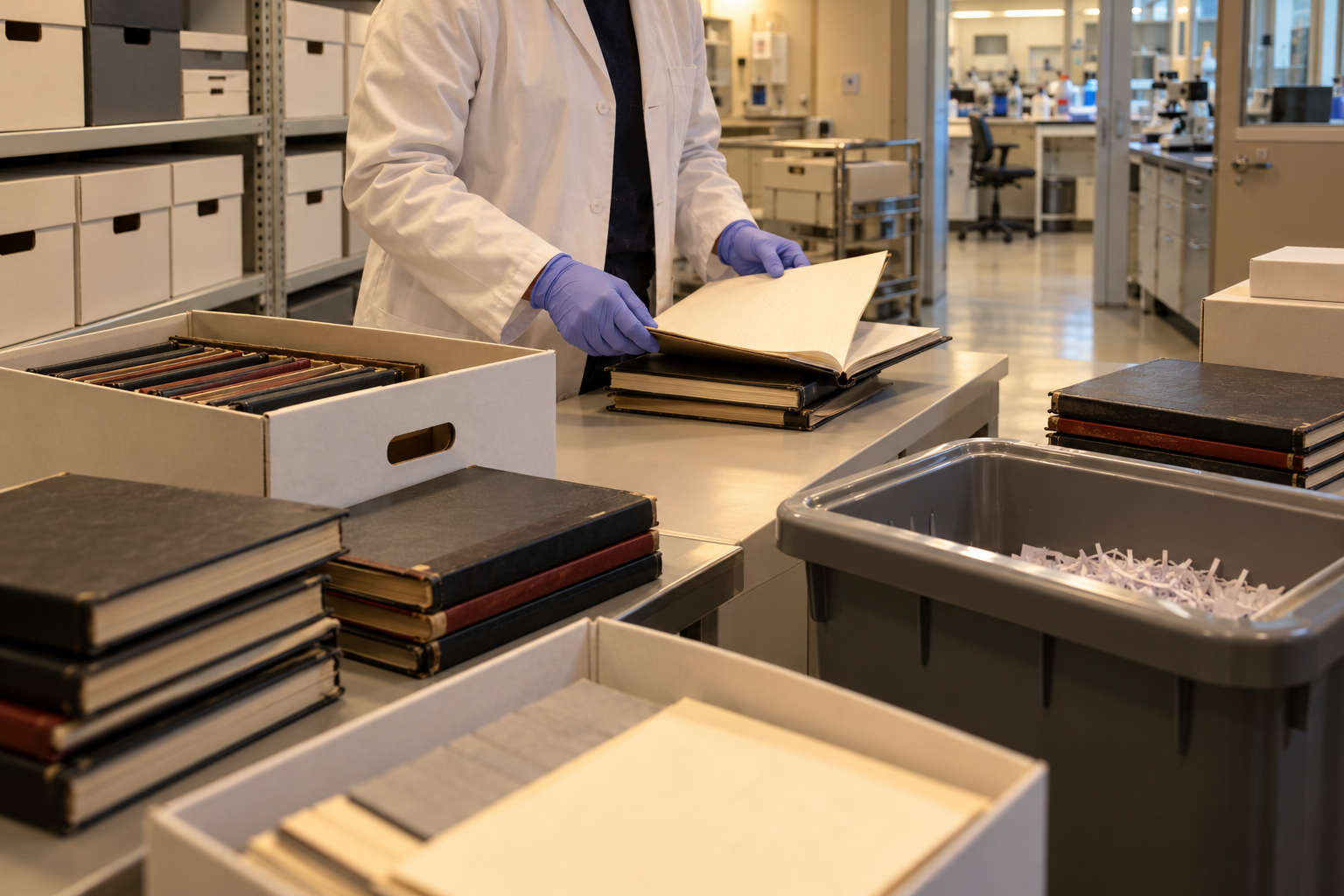
Retain records by authority and milestone
Patent work may involve legal holds, sponsor rules, research-integrity requirements, contracts and institutional schedules. Do not invent one universal retention period, and do not describe ordinary delete as guaranteed sanitization.
After filing, the owner distinguishes the filed application, disclosure, supporting evidence, working drafts, backups and devices. Counsel and records staff identify authority, hold status and approved disposition for each class.
Run the control in five steps
- 01Inventory filed, supporting, working, backup and device copies.
- 02Identify legal, sponsor, institutional and contractual authorities.
- 03Check disputes, investigations, holds and continuing research needs.
- 04Assign retain, transfer, delete or sanitize by copy class.
- 05Verify disposition and record the accountable approver.
Preserve the decision trail
Record copy class, location, authority, event trigger, hold check, disposition, method, date, verification and approver.
Stop and investigate when
- Filing automatically triggers deletion of all drafts.
- Vault deletion is called complete media sanitization.
- Backups and collaborator copies are absent from the inventory.
State what encryption does not prove
Does not replace provider permissions, guaranteed backup, password recovery or enterprise identity management. It also does not determine inventorship, patentability, filing priority, evidentiary weight or disclosure authority. Obtain appropriate counsel.
Invention notebook security questions
Is there one patent-notebook retention period?
No. Obtain the applicable legal and institutional schedule.
Is ordinary deletion enough?
Not for every risk or medium; use an approved sanitization decision.
Sources for this decision
Links support specific boundaries and do not imply endorsement.